If you’ve been shopping for a new roof in New England, there’s a good chance you’ve run into wildly different warranty offers. One contractor promises a 10-year workmanship warranty, while another advertises a “50-year” or even “lifetime” warranty.
It’s confusing, and for homeowners trying to protect one of their most valuable assets, warranty confusion often leads to anxiety, hesitation, or worse… choosing a contractor based on a promise they don’t fully understand.
The real tragedy? Many homeowners discover the limitations of their warranty only when something goes wrong, and by then, it’s too late.
At Adam Quenneville Roofing & Siding, we hear this question constantly. We’ve replaced thousands of roofs across New England’s challenging climate, and we’ve seen firsthand how dramatically warranty coverage can differ not just in years, but in what actually gets covered.
We’ve also helped many homeowners who thought they were protected under a “50-year” warranty, only to discover that the coverage was prorated, materials-only, non-transferable, or voided due to improper installation by their previous contractor. In this article, you’ll learn exactly why warranty lengths vary, what a 50-year warranty actually covers, and how to compare warranties apples-to-apples so you can make an informed decision, not an emotional one. By the end, you’ll know what truly matters (and what doesn’t) when evaluating roof warranties.
And to be clear: We are not here to steer you toward the longest or shortest warranty. We simply want you to understand what’s real, what’s marketing, and how to choose the roofer you trust, whether that’s us or someone else.
What’s the Difference Between 10-Year and 50-Year Roofing Warranties?
The difference between a 10-year warranty and a 50-year warranty is the type of warranty being referred to. A 10-year warranty almost always references a workmanship warranty (the quality of the installation), and a 50-year warranty always refers to a manufacturer’s warranty (the quality of the product).
When homeowners compare roofing quotes, the warranty section tends to cause the most confusion and often, the most misunderstandings. Many assume a longer warranty always means better protection, but in reality, the length of the warranty tells only part of the story. What matters most is who is backing the warranty, what it covers, and how it applies in real-world scenarios.
The Difference Between a Manufacturer Warranty and a Workmanship Warranty
Understanding roofing warranties starts with recognizing that there are two completely different categories, and they protect against entirely different types of problems:
1. Manufacturer Warranty (Materials)
This is the warranty you’ll typically see advertised as “50-year,” “lifetime,” or “extended lifetime coverage.”
- Covers shingle or material defects, not installation mistakes.
- A manufacturer’s warranty often includes tiers: basic coverage, extended coverage, non-prorated periods, and prorated periods.
- They’re offered by shingle manufacturers like GAF, Owens Corning, and CertainTeed.
- Their long warranty terms are tied to the product, not the installer, although extended terms require certified contractors.
Typical homeowner misconception: They believe this warranty protects them if their roof leaks, but most leaks happen due to installation issues, which manufacturers don’t cover.
2. Workmanship Warranty (Installation/Labor)
This is the warranty provided directly by the roofing contractor and is usually 5, 10, 15 years, sometimes more.
- A workmanship warranty covers errors made during the installation process.
- Only the contractor, not the manufacturer, backs this warranty.
- If the contractor goes out of business, this warranty typically disappears with them.
- This warranty is the one that actually protects homeowners from the issues most likely to occur.
Important distinction:
A contractor offering a “10-year workmanship warranty” is backing their craft, not the materials.
For example, we cover 100% of the work we perform; nothing will come out of your pocket for the duration of the warranty you selected. With our workmanship guarantee, nothing is left to chance.
Why Warranty Length Doesn’t Tell the Whole Story
Long warranty terms sound great, but the structure of the warranty matters far more than the headline number.
Most 50-year warranties aren’t 50 years of full coverage.
A typical “50-year” or “lifetime” manufacturer warranty includes:
- Non-prorated coverage for the first 10-15 years (During the first 10–15 years, a non-prorated warranty covers 100% of the replacement materials if a manufacturing defect occurs; after that, coverage decreases as the roof ages.)
- Prorated coverage afterward, meaning the value decreases every year
- Possible coverage exclusions include ventilation issues, storm damage, improper installation, or if you don’t maintain the roof properly.
In many cases, the manufacturer’s warranty may only provide partial material credits, but not cover the full cost of replacing your roof.
Meanwhile, a “10-year workmanship warranty” may protect you in far more situations.
Since most roofing problems stem from installation, not defective shingles, a shorter workmanship warranty could offer far more practical protection than a long manufacturer term.
For example, a workmanship warranty often covers things like:
- Nail pops
- Flashing errors
- Incorrect ventilation
- Improper underlayment installation
- Starter strip mistakes
- Poor sealing or alignment
None of these issues are covered by a manufacturer, regardless of whether the warranty is a “lifetime” warranty.
A long warranty term doesn’t mean you’re getting better protection; it means you need to read the fine print.
Are 50-Year Roofing Warranties Legit?
A 50-year warranty is legitimate as long as the conditions of the warranty are met. What we’ve found is that roughly 10-15% of issues are true manufacturing defects (that would be covered under warranty). A manufacturer’s warranty:
- Covers defects in the materials, not installation.
- May require the use of specific shingles, underlayments, or ventilation systems.
- May require installation by a factory-certified contractor.
- Usually includes a non-prorated period (full coverage) followed by a prorated period (partial reimbursement).
When homeowners hear the phrase “50-year roof warranty” or “lifetime coverage,” it’s natural to assume they’re getting exceptional long-term protection. And while these warranties are real, they are often misunderstood. The truth is that 50-year warranties have specific conditions, limitations, and requirements that every homeowner should understand before relying on them.
The catch with 50-Year Roofing Warranties
Most warranty claims homeowners want to make, such as leaks, blow-offs, or premature deterioration, are caused by installation-related issues, not product defects.
This is why understanding what a warranty covers is more important than the number of years printed on the brochure.
Real Life Example: We recently had a warranty claim come through for a roof installed by an out-of-state Connecticut contractor. The homeowner was experiencing leaks, and after inspection, it was clear the issue wasn’t a material defect; it was an installation problem. Because the original roofer had gone out of business, GAF stepped in under the Golden Pledge Warranty and contacted us, as a Master Elite contractor, to handle the repair. This is a great real-world example of how workmanship issues are far more common than true product failures and why proper installation and certified contractors matter.
50-Year Roofing Warranties Are Only Offered Through Certified Contractors
Extended 30-, 40-, and 50-year warranties usually require homeowners to hire contractors who hold special certifications with the shingle manufacturer. For example:
- GAF Master Elite®
- Owens Corning Platinum Preferred®
- CertainTeed Select ShingleMaster®
These designations allow the contractor to register enhanced warranties on the homeowner’s behalf.
Why Does Being a Certified Contractor Matter?
- The manufacturer is willing to extend coverage only when the installer meets rigorous standards.
- Certified contractors must follow specific installation guidelines.
- The certification itself is not permanent; contractors must maintain good standing to retain the ability to offer premium warranties.
At Adam Quenneville Roofing & Siding, we hold the GAF Master Elite® Certification, a designation earned by less than 2% of roofing contractors in North America. This certification isn’t just a badge; it’s what allows us to offer the GAF Golden Pledge® Limited Warranty.
We once met with a homeowner who had received two quotes: both roofers claimed to offer “lifetime” warranties. But only after digging deeper did they realize that the competitor wasn’t GAF-certified, meaning they could only register the basic shingle warranty, which covered materials only and didn’t include workmanship protection from GAF.
When they learned that the Golden Pledge Warranty included 25 years of workmanship coverage backed by GAF (not just the roofing company), plus 50 years of system coverage, the choice was clear. They later told us:
“I had no idea two contractors could install the same shingles but offer totally different warranties.”
That’s why choosing a certified installer matters more than most people realize.
Common Misconceptions About “Lifetime” or 50-Year Warranties
Despite their legitimacy, 50-year or “lifetime” warranties are often misunderstood. Three of the biggest misconceptions include:
Misconception 1: “Lifetime” means my lifetime.
In roofing language, “lifetime” refers to the expected serviceable life of the shingle, not how long you live in your home. And this “lifetime” varies by climate, roof ventilation, installation quality, and warranty tier.
Misconception 2: A 50-year warranty covers everything, including labor.
In reality:
- Many extended warranties cover materials only after the initial non-prorated period.
- Labor may be partially covered, or not covered at all, unless the homeowner purchased a premium warranty tier.
This means homeowners may still face labor charges even during the warranty period.
Misconception 3: A 50-year warranty guarantees a 50-year roof.
Most asphalt shingle roofs, regardless of warranty, last 20–30 years in typical conditions.
Factors that reduce roof lifespan include:
- Poor installation
- Severe weather
- Inadequate ventilation
- Ice dams
- Improper maintenance
- Excessive heat exposure
Even the best shingles cannot overcome a poorly installed roofing system.
Real Life Example: We recently inspected a roof that had been installed 20 years ago by a well-known big-box home improvement store. They had used the exact same GAF shingles we install, which should last at least 30 years, so the homeowner assumed the product was the issue when the roof started curling and losing granules.
But when we pulled back the shingles, we found two major installation problems: the shingles had been improperly nailed, and there was no ventilation at the ridge, meaning heat and moisture were trapped in the attic. The shingles themselves were perfectly fine; they had simply been baked from underneath, causing curling, cracking, and premature failure. What looked like a “bad shingle” was actually a ventilation and installation error, not a product defect.
Why Some Roofers Promote 50-Year Warranties
If you’ve gathered multiple roofing quotes, you may have noticed that some contractors emphasize their “50-year warranty” front and center. They highlight it in bold print on brochures, mention it repeatedly during sales calls, and sometimes use it as the main differentiator between themselves and their competitors.
Why? Because extended warranties are powerful marketing tools. But the reasons they’re used and what they actually mean are far more nuanced.
Manufacturer Programs as a Sales Advantage
Roofing manufacturers allow contractors to offer extended warranties only if they meet specific certification requirements. These certifications signal that the contractor has met certain training, workmanship, and business standards.
For a roofer, being able to advertise a 30, 40, or 50-year warranty sends a message of professionalism and credibility. It allows them to say:
- “We’re certified.”
- “We meet the manufacturer’s highest standards.”
- “We can access warranties other companies cannot.”
These points aren’t gimmicks on their own; they’re legitimate advantages, and many contractors use them intentionally to stand out. Longer warranties feel safer. Bigger numbers sound more premium. And, understandably, homeowners assume longer automatically means better. In an industry where most customers don’t replace roofs often and may already feel uncertain or overwhelmed, that emotional reassurance carries a lot of weight
Real Life Example: We recently met with a homeowner who told us we were the second contractor to quote their roof. The first contractor had already “won them over” by offering what they called a lifetime warranty. The homeowner was ready to sign with them on the spot for that reason alone.
Before they committed, we offered to take a quick look at the warranty details in their quote. It turned out that the “lifetime” only covered materials, not workmanship. If the roof failed because of improper installation, ventilation issues, flashing mistakes, or any labor-related problem, they would have been on the hook for 100% of the repair costs.
Once we explained the difference between a long material warranty and the GAF Golden Pledge warranty, the homeowner realized the first offer wasn’t nearly as protective as it sounded.
Warranty Length as a Trust Signal (Even If It’s Mostly Marketing)
Many contractors know that homeowners compare roofing companies based on warranty terms because it feels like a simple apples-to-apples metric. As a result, some companies highlight the warranty length as their primary differentiator, even when:
- The workmanship quality may not be higher
- The coverage is mostly prorated
- The meaningful part of the warranty only lasts 10–15 years
In other words, the warranty becomes a trust shortcut.
The contractor is signaling:
- “We stand behind our work.”
- “Our materials are top-tier.”
- “We are endorsed by the manufacturer.”
But here’s the reality homeowners need to know:
A long warranty does not automatically mean a better installation.
A contractor can install a roof improperly and still advertise a 50-year warranty because the warranty applies to the materials, not their workmanship.
Meanwhile, a contractor offering a 10-year workmanship warranty might provide installations that perform flawlessly for decades.
The Perception Advantage: A 50-Year Warranty Makes the Quote Look “Better”
Sales teams know that when homeowners compare roofing quotes side-by-side:
- Similar pricing
- Similar products
- Similar timelines
… the warranty becomes the tiebreaker.
This is why the industry leans heavily on warranty length as a differentiator, even though the homeowner’s real-world protection often depends much more on the contractor’s workmanship than the manufacturer’s paperwork.
The unfortunate reality is that some companies rely on extended warranties to compensate for:
- Lack of clear installation processes
- Minimal training
- Poor communication
- High-pressure sales styles
The warranty becomes the “shiny object” that diverts focus from the risk factors that actually determine roof performance.
Does a 50-Year Warranty Mean the Roofer Is Better? Not Necessarily.
The ability to offer a 50-year warranty means:
- The roofer meets the manufacturer’s minimum certification criteria
- They can sell and register enhanced warranties
It does not guarantee:
- Better craftsmanship
- Better crew training
- Better ventilation knowledge
- Better flashing installation
- Longer-lasting roofs
In many cases, warranty terms tell you more about the manufacturer’s marketing strategy than the contractor’s actual skill.
Why Other Roofing Contractors Only Offer 10-Year Warranties
Not every roofing contractor advertises a 30-, 40-, or 50-year warranty. In fact, many reputable and highly skilled roofers offer shorter but more straightforward warranty terms, such as 5, 10, or 15 years. Homeowners often assume this is a sign of lower quality, but in reality, there are several honest, practical, and sometimes strategic reasons why a contractor chooses to offer a shorter warranty.
Understanding these reasons helps you evaluate warranty terms based on substance, not just numbers.
They’re Being Upfront About What They Control
A contractor’s workmanship warranty covers installation quality, which is the part they can directly stand behind. Good contractors know:
- They control their crew’s training.
- They control their installation processes.
- They control their follow-through and customer service.
- They do not control manufacturing defects or unpredictable homeowner maintenance habits.
By offering a 5-, 10-, or 15-year workmanship warranty, the contractor is essentially saying:
“We guarantee our work. We’re not going to make promises we can’t honor just to win the sale.”
This may actually reflect more honesty than a company that leans heavily on a marketing-driven 50-year claim.
A Shorter Workmanship Warranty Can Actually Be a Sign of Transparency
Many smaller or locally owned roofing companies avoid offering extended warranties, not because their work is inferior, but because:
- They don’t want to force homeowners into specific manufacturer bundles.
- They prefer flexibility in material selection.
- They want to avoid manufacturer warranty registration fees that inflate project cost.
- They’d rather offer clear, straightforward coverage instead of complicated fine print.
It’s a strategic choice rooted in transparency.
From our experience in the industry, some of the very best roofers in America offer 10-year workmanship warranties because they take full responsibility for what they control and no responsibility for what they don’t.
Shorter Warranties Don’t Mean Shorter Roof Lifespans
Contractors who offer shorter warranties often use the same premium materials as companies offering extended warranties. The shorter coverage has nothing to do with:
- The shingle quality
- How long the roof is expected to last
- The quality of installation
Instead, the shorter warranty simply reflects the contractor’s desire to provide a clear, honest, and manageable guarantee without tying themselves to manufacturer marketing programs.
A well-installed asphalt shingle roof, regardless of the warranty, commonly lasts 20 to 30 years, depending on climate and ventilation.
Some Contractors Don’t Participate in Manufacturer Certification Programs
Offering extended 30, 40, or 50-year warranties generally requires the roofer to:
- Use specific components (full system bundles)
- Pay certification fees
- Meet volume requirements
- Renew credentials annually
- Follow strict manufacturer installation checklists
Not every contractor wants to operate this way.
Many choose not to pursue certifications because:
- Certification increases job cost
- They don’t want to be tied to a single manufacturer
- Their business model prioritizes affordability for homeowners
- Their teams already exceed industry standards without needing a certification badge
Going “uncertified” does not mean the roofer is unskilled. It often means they’re protecting pricing flexibility or resisting manufacturer bundling requirements.
A Shorter Warranty May Actually Protect Homeowners Better
Because workmanship warranties cover the issues that really cause roofing problems, a contractor with a 10-year workmanship warranty may offer more practical protection than one using a 50-year manufacturer warranty to sell jobs.
Here’s why:
- Workmanship issues appear within the first 2–8 years.
- Manufacturer defects are extremely rare.
- A straightforward workmanship warranty means fewer loopholes.
- Homeowners know exactly who to call and what to expect.
In many cases, the most meaningful protection happens in the first decade, regardless of any marketing language in a manufacturer’s warranty brochure.
What Actually Matters More Than Warranty Length
With so many warranty options: 10-year, 25-year, “lifetime,” 50-year, it’s easy for homeowners to assume the number of years is the most important factor. But when you look at real-world roof performance, warranty length is far less important than the factors that actually determine whether your roof will fail early or last decades.
Here’s what truly matters when buying a new roof (and what even the best warranty can’t compensate for).
The Installer’s Track Record
A roof’s lifespan has far more to do with who installs it than the number printed on a warranty brochure.
Even the highest-grade shingles will fail early if they’re installed incorrectly. Meanwhile, a high-quality installer can make a standard shingle last well beyond its expected service life.
Most roof failures happen because of:
- Improper nail placement
- Overdriven or underdriven nails
- Poorly installed flashing
- Incorrect starter course
- Insufficient attic ventilation
- Misaligned shingles
- Rushed workmanship from subcontracted crews
The warranty does not cover most of these issues.
This is why the reputation and track record of the installer matter more than anything else, including the manufacturer’s warranty term.
How Long the Company Has Been Around (and How Long They’ll Stay Around)
A warranty is only as good as the company backing it.
Even if you choose a roofer with a 25-year workmanship warranty, it’s worthless if the company:
- Goes out of business
- Changes ownership
- Rebrands or switches license numbers
- Leaves the area
- Stops honoring older warranties
Unfortunately, the roofing industry sees a high turnover rate. Many contractors don’t survive beyond 5–7 years.
That means a roofer offering a 20–30-year workmanship warranty may not realistically be around to support that promise.
Meanwhile, a contractor with 10 or 15 years in business and a 10-year workmanship warranty often delivers far more reliable long-term protection.
At Adam Quenneville Roofing & Siding, we have been serving New England homeowners for over 30 years, and during that time, we’ve installed and maintained thousands of roofs still under active warranty today. That longevity matters not just for reputation, but for homeowners who want reassurance that their roofing company will still be around if they ever need warranty support.
Real-World Claim Processes: What Actually Happens When You File a Claim
Many homeowners assume warranty claims are fast, simple, and generous.
Reality is more complicated.
Manufacturer warranty claims typically require:
- An inspection by a manufacturer representative
- Proof of proper installation
- Documentation of attic ventilation
- Evidence that the problem is due to a material defect, not workmanship
- Verification that the homeowner maintained the roof
- Verification that no unrelated damage (storms, debris impact) contributed
If approved, coverage may include:
- Replacement shingles only
- Partial credit based on prorated years
- Reduced or no labor reimbursement
In many cases, the manufacturer may deny the claim because the issue is installation-related, even when the roof is using “50-year” shingles.
Workmanship warranty claims go differently:
When a roofing issue is caused by installation problems, a good contractor will come out, fix it, and leave you with a functioning roof at no charge and with no lengthy approval process.
This is why workmanship matters more than years on paper.
Materials Are Rarely the Problem… Installation and Ventilation Are
Manufacturers produce shingles at scale with strict quality controls. While defects can occur, they are far less common than homeowners assume.
Most roof failures begin with:
- Poor attic ventilation leading to shingle blistering
- Incorrect flashing causing water intrusion
- Underlayment applied incorrectly
- Valleys and penetrations are improperly sealed
- Nailing pattern mistakes
- Ridge vent installation issues
- Ice dam–related failures
A 50-year warranty covers none of these.
This is why a well-installed roof with a 10-year workmanship warranty often performs better and lasts longer than a poorly installed roof with a 50-year manufacturer warranty.
The Roofing System as a Whole Matters More Than Any Single Component
A roof isn’t just shingles. It’s a system of components designed to work together:
- Underlayment
- Ice and water barrier
- Flashings
- Drip edge
- Starter strip
- Shingles
- Ridge vents and exhaust vents
- Intake vents
- Sealant and fasteners
Extended warranties often require full-system installation using one manufacturer’s components.
But even then, the system only performs as designed if installed correctly. Misaligned shingles or poor ventilation can drastically shorten roof life, even if every component carries a “lifetime” warranty.
How to Compare Roofing Warranties (Without Getting Misled)
Once you understand the difference between workmanship warranties and manufacturer warranties and how much of the warranty language is shaped by marketing it becomes much easier to compare offers from different roofing companies. But for most homeowners, warranty documents still feel overwhelming, full of vague terms and complicated exclusions.
Here’s a simple, step-by-step way to compare warranties so you can make a confident decision based on what you’re actually getting, not just the number printed on the brochure.
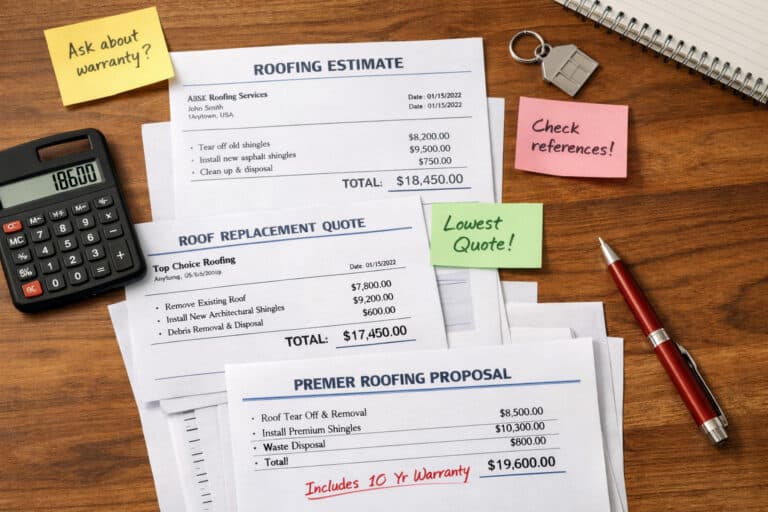
Questions to Ask Every Roofer Before You Sign Anything
Instead of asking, “How long is the warranty?”, homeowners should ask the questions that reveal the quality, coverage depth, and practical protections behind the warranty.
Use these questions as a checklist when evaluating multiple roofing quotes:
1. What exactly does this warranty cover? Materials, labor, or both?
A long manufacturer’s warranty may only cover materials, while a shorter workmanship warranty may cover the issues most likely to occur.
2. How long is the non-prorated (full coverage) period?
This is the most valuable part of any manufacturer’s warranty.
Many “50-year” warranties only offer 10–15 years of full coverage before prorating kicks in.
A roof problem that appears in year 18 under a prorated warranty may only be worth pennies on the dollar.
3. Is labor included in the warranty?
Many extended manufacturer warranties cover only the shingles themselves, not the labor to tear off, haul away, and reinstall them.
Labor is often the most expensive part of roof replacement.
4. Is the warranty transferable to a new homeowner?
If you plan to sell your home within 5–10 years, transferability matters. Some warranties:
- Transfer once
- Reduce coverage after transfer
- Require a fee
- Require filing paperwork within a short window
Failure to transfer correctly can void the warranty entirely.
5. What specific conditions can void this warranty?
Warranties can be voided by:
- Poor attic ventilation
- Improper installation
- Modifying the roof structure
- Incorrect repairs by other contractors
- Pressure washing
- Failing to maintain roof components
Some homeowners void their warranty unintentionally.
6. What happens if the contractor goes out of business?
A 20-year workmanship warranty means nothing if the company disappears in year 5.
Ask specifically:
- Who backs the workmanship warranty?
- Is it backed by an insurance policy?
- Does the manufacturer offer any labor protection?
7. Does your quote include all materials required by the manufacturer to keep the warranty valid?
Extended manufacturer warranties often require:
- Matching underlayment
- Starter shingles
- Ridge cap shingles
- Approved ventilation components
- Ice & water barrier
- Specific fasteners
If a contractor uses off-brand components, it can void the enhanced warranty.
What Roofing Warranties Really Tell You
When comparing roofing quotes, it’s easy to get hung up on the number of years printed on a warranty. But as you’ve seen, warranty length is often more of a marketing tool than a true indicator of protection or roof performance.
What matters far more than whether a warranty says 10, 25, or 50 years is:
- Who installs your roof
- How well they install it
- Whether their workmanship warranty is clear and reliable
- Whether the company will still be around to honor it
- Whether the roofing system is designed and ventilated correctly
A long manufacturer’s warranty can offer peace of mind, but it can’t fix poor installation. And it won’t protect you from the issues that cause most roof failures.
A shorter workmanship warranty from a trusted, established contractor often offers greater real-world protection than a long manufacturer claim with fine print and limitations.
At the end of the day, the most important “warranty” you’re buying is the reputation, processes, and integrity of the roofing contractor you choose.