At Adam Quenneville Roofing & Siding, we talk to homeowners every week who are trying to make the smartest possible decision during a roof replacement. One of the questions that comes up more often than people expect is this: Should I choose a ridge vent or keep the wind turbines?
If you are asking this, you are probably already thinking beyond shingles and colors. You are thinking about how your roof system will perform, how long it will last, and whether you are about to spend good money without fixing the full problem.
That concern is valid.
Poor attic ventilation can contribute to trapped heat, moisture buildup, and unnecessary stress on your roofing system. In New England, where homes face hot summers, cold winters, snow loads, and ice dam concerns, ventilation is not a small detail. It is an important part of how your roof protects your home.
At Adam Quenneville Roofing & Siding, we look at attic ventilation through the lens of manufacturer training, building code best practices, and years of real-world roofing experience. In many homes, that means creating balanced airflow with intake and exhaust working together, often through a soffit-and-ridge vent system.
At the same time, we want to be transparent about our perspective. We install ridge vent systems on many homes because, in the right situation, they are often the better long-term solution. But not every roof is automatically a good candidate for ridge venting. The right answer depends on the roof design, the attic layout, and whether the home has enough intake ventilation to support the system.
In this article, we’ll explain how ridge vents and wind turbines work, why many homeowners choose ridge vents today, when a wind turbine might still make sense, and how to know which option is right for your home.
Quick Answer: Are ridge vents better than wind turbines?
In many cases, yes.
For a modern roofing system, a ridge vent is often the better choice because it allows exhaust along the highest point of the roof, has no moving parts, creates a cleaner roofline, and typically requires less maintenance over time. Adam Quenneville’s own ventilation guidance emphasizes that roof ventilation works best when outside air can move continuously through the attic and exit high on the roofline.
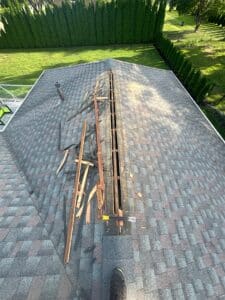
That said, a ridge vent is only as good as the system around it. If your home does not have enough soffit ventilation, or if the roof design limits airflow, a ridge vent may not perform the way it should.
That is why the real question is not, “Which vent is better in general?”
It is, “Which ventilation system is right for this roof?”
What’s the difference between a ridge vent and a wind turbine?
A ridge vent is an exhaust vent installed along the peak of the roof. Because heat and moisture rise, the ridge is the natural place for attic air to escape. Ridge vents usually work best when paired with soffit vents or another intake system that brings fresh outside air in from below. AQRS describes this as a continuous airflow system through the attic.
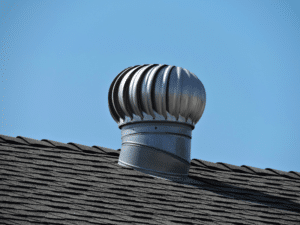
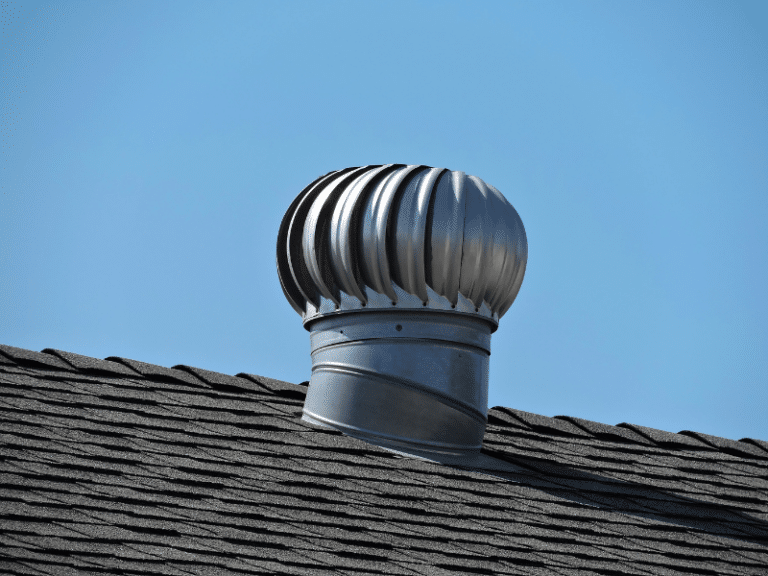
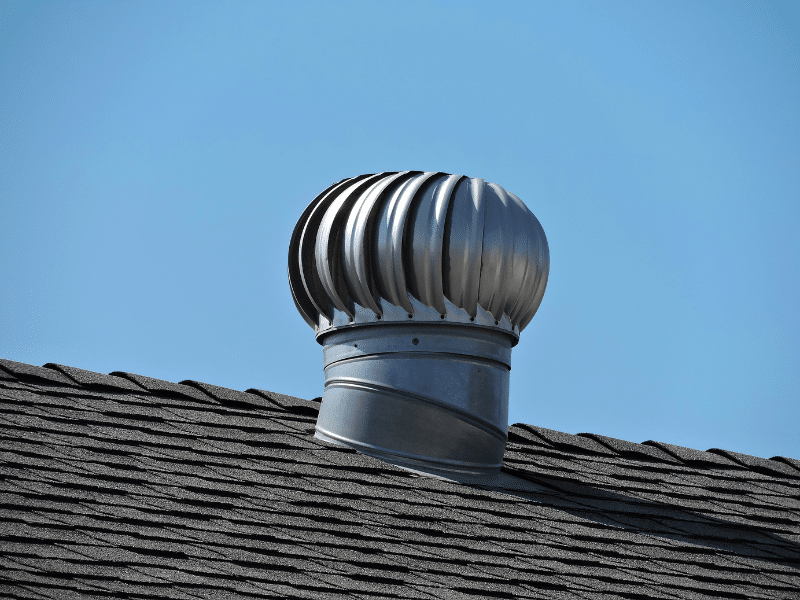
A wind turbine is a rooftop vent that spins and pulls air from the attic. You see them more often on older homes. They can move air, but they do it through isolated openings rather than through a continuous opening along the roof peak.
When we explain this to homeowners, we usually put it simply:
A wind turbine ventilates from a few specific spots.
A ridge vent ventilates across the length of the ridge.
That difference matters.
6 reasons many homeowners choose a ridge vent over wind turbines
Ridge vents provide more even ventilation
The biggest practical advantage of a ridge vent is that it runs continuously along the roof peak. That means attic air can escape more evenly, instead of being pulled from only a few isolated openings. On longer roof planes especially, that continuous exhaust path tends to create a more balanced ventilation pattern than a handful of turbines. This does not mean a turbine cannot help. It can. But if you are comparing a few isolated exhaust points versus continuous exhaust at the ridge, the ridge vent often gives you a more uniform system.
Ridge vents have no moving parts
This is one of the simplest and strongest arguments in their favor. A ridge vent does not spin. It does not rely on bearings. It does not have exposed mechanical movement that can wear out, seize, loosen, or become noisy over time. Wind turbines, by design, depend on moving parts. On older homes, we often see turbines that no longer spin properly, have become noisy, or have simply aged out. For homeowners who want less maintenance and fewer things to go wrong, ridge vents are usually more appealing.
Ridge vents usually perform more consistently over time
A properly installed ridge vent is passive, but dependable. It does not need the “right” amount of wind to function the way a spinning turbine does. It is built into the roofline and designed to let naturally rising heat and moisture escape from the highest point. That consistency is one reason many homeowners choose ridge vents during a roof replacement. They want a ventilation system that is integrated into the roof, not one that depends on an exposed rotating component year after year.
Ridge vents create a cleaner roofline
Some decisions are about performance. Some are about looks. Most are about both.
A ridge vent has a much lower profile than multiple wind turbines sticking up from the roof. From the ground, it usually blends into the roofline far better.

For homeowners investing in a full roof replacement, curb appeal matters. A cleaner-looking roof is not the main reason to choose a ridge vent, but it is often a real advantage.
Ridge vents may be less vulnerable in storms
In New England, weather matters. High winds, driving rain, snow, ice, and hail all put roofing components to the test. Because wind turbines sit up above the roof surface and include moving parts, they are often more vulnerable to storm-related wear and damage than a lower-profile ridge vent system. That does not mean every turbine fails in a storm or that every ridge vent is automatically superior. Installation quality still matters. But many homeowners prefer the simpler, lower-profile design of ridge ventilation in a region where weather can be hard on roof components.
Ridge vents support a healthier overall roofing system
This is where the conversation goes beyond just choosing a vent style.
Good ventilation helps the entire roof system manage heat and moisture more effectively over time. That matters because problems in the attic do not stay in the attic. They can affect shingle performance, roof decking, and the overall condition of the home.
A properly balanced ventilation system helps air move the way it should, which can reduce the buildup of excess heat and moisture and support better roof performance year-round. That is why we look at ridge venting as more than just a feature. When it is the right fit for the home, it can be an important part of a healthier, longer-lasting roofing system.
Are ridge vents always better than wind turbines?
No. And any roofer who says otherwise is oversimplifying the issue. A ridge vent is often an excellent choice, but it is not a magic fix. It has to be the right fit for the house. There are situations where a ridge vent may not be ideal, including:
- Homes without enough intake ventilation Roof designs that do not allow proper airflow
- Attics with unusual compartmentalization.
- Existing systems that have been mixed and altered over time
- Cases where the real problem is insulation or air sealing, not ventilation alone
This is one of the biggest misconceptions homeowners have. They think changing the exhaust vent automatically solves the problem.
Sometimes it does.
Sometimes it does not.
A trustworthy roofing contractor should evaluate the entire attic ventilation system before recommending a change.
Ridge vent vs. wind turbine: which works better in hot weather?
In hot weather, the attic can quickly become a heat trap.
Because heat rises, the peak of the roof is the natural place for that hot air to escape. A ridge vent runs along that highest point, allowing heat to vent more evenly across the roofline.
Wind turbines can also help remove hot attic air, but they do it from specific points rather than along the full ridge. That is one reason many homeowners and roofers prefer ridge vents when the goal is more balanced ventilation, especially on larger roof sections.
But here is the part homeowners often miss:
No exhaust vent works properly without an intake.
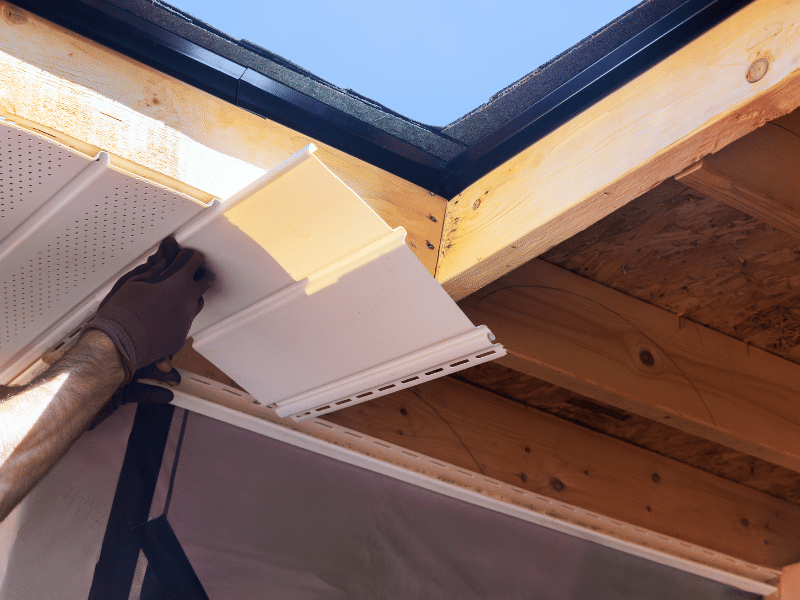
If your soffit vents are blocked, missing, or insufficient, neither a ridge vent nor a turbine will perform as well as it should.
Ridge vent vs. wind turbine: which is better in high-wind or hail-prone areas?
In regions with tough weather, simplicity is often an advantage.
A wind turbine has a raised profile and moving parts. A ridge vent is lower profile and passive. That is one reason many homeowners replacing older roofs choose ridge vents when they want a more durable-looking, lower-maintenance setup.
Still, the vent type is only part of the story.
The better questions are:
- Was it installed correctly?
- Is it supported by the right intake ventilation?
- Is it the right fit for the roof design?
- Are the materials high-quality?
A badly installed ridge vent is still a bad system. But if both are installed properly, many homeowners in storm-prone areas prefer ridge vents because of their cleaner and simpler design.
Can you mix ridge vents and wind turbines on the same roof?
Usually, no.
Mixing exhaust vent types is generally not a good idea.
A roof ventilation system works best when outside air enters through intake vents low on the home and exits through exhaust vents high on the roof. When you mix ridge vents and wind turbines, those exhaust points can compete with each other.
Instead of drawing fresh air properly through the soffits, one exhaust opening may draw from another. That reduces the system’s efficiency.
So if a homeowner is switching from turbines to ridge vents, we typically recommend evaluating the whole system and removing the old exhaust vents rather than trying to run both together.
Does a ridge vent need soffit vents to work properly?
In most cases, yes. A ridge vent is an exhaust vent. It needs air intake from below to work as intended. AQRS’s ventilation guidance specifically points to the pairing of soffit and ridge vents as the ideal route for continuous airflow through the attic. This is one of the most important things to understand about roof ventilation. A ridge vent by itself is not a complete solution. It is one half of a system. When a homeowner adds ridge vent but ignores intake ventilation, the results are often disappointing. The vent is there, but the airflow is not balanced.
What are the pros and cons of ridge vents?
Pros of ridge vents
Ridge vents offer:
- Continuous exhaust along the roof peak
- No moving parts
- Lower maintenance
- A clean, low-profile appearance
- Strong compatibility with many modern roofing systems
Cons of ridge vents
They also have limitations:
- They must be installed correctly
- They need proper intake ventilation
- They are not ideal for every roof design
- They will not solve every attic problem on their own
That last point matters. A ridge vent can be an excellent solution, but only when it is part of a properly designed system.
What are the pros and cons of wind turbines?
Pros of wind turbines
Wind turbines still have some advantages in certain situations:
- They may already be part of the home’s current setup
- They can improve ventilation in some older systems
- They can move air effectively under the right conditions
Cons of wind turbines
But many homeowners see downsides such as:
- Moving parts that wear out
- Greater visibility on the roof
- More maintenance over time
- Less even ventilation coverage
- More vulnerability to age and weather exposure
That is why many homeowners with older turbines ask the same question during replacement: Should I keep these, or is this the right time to upgrade the entire ventilation system?
How do you know whether your home should have ridge vents or wind turbines?
You need an inspection that looks at the full system.
A good roofing assessment should include:
- Roof design
- Attic layout
- Existing intake ventilation
- Existing exhaust setup
- Signs of trapped heat or moisture
- Insulation and air sealing conditions
- Whether multiple vent types are currently competing
This is where experience matters. At AQRS, the goal is not to recommend ridge vents because they sound modern. The goal is to recommend the system that fits the house and explain why.
If a contractor cannot clearly explain why a ridge vent is right, why it may not be right, and what conditions are required for it to work, that is a red flag.
Signs your current attic ventilation may not be working well
Homeowners often do not realize they have a ventilation issue until they see symptoms.
Common signs include:
- Upstairs rooms that stay unusually hot
- Excessive attic heat
- Moisture or frost in the attic
- Musty smells
- Premature shingle aging
- Rusted nails or damp roof decking
- Ice dam problems in winter
AQRS’s winter ventilation guidance notes that poor airflow can contribute to moisture trouble and to the freeze-thaw conditions behind ice dam formation.
Those symptoms do not automatically mean you need ridge vents. But they do mean the roof system deserves a closer look.
Is upgrading to a ridge vent worth it during a roof replacement?
Very often, yes. A roof replacement is usually the best time to evaluate and correct ventilation because the system is already being rebuilt. It is much easier to address exhaust design, intake needs, and overall balance when you are already replacing the roof.

For many homeowners, that makes the decision less about the cost of “adding a ridge vent” and more about the value of doing the whole roof system correctly while the project is already underway. That does not mean every home should automatically switch. But if the house is a good candidate, roof replacement is usually the most practical time to make the change.
Questions to ask your roofer about ridge vents
Before you agree to any ventilation recommendation, ask these questions:
Will my home have enough intake ventilation?
If the answer is vague, keep asking.
Should old wind turbines be removed?
If you are switching systems, that should be part of the discussion.
Will a ridge vent work with my roof design?
Not every roof is the same.
How will this affect roof performance and longevity?
Your roofer should be able to explain this in plain English.
Is ventilation included in the roof replacement estimate?
You should know exactly what is being installed and why.
These questions protect homeowners from half-solutions and help them compare roofing quotes more intelligently.
Next steps for choosing a ridge vent over wind turbines
If you are trying to decide between a ridge vent and wind turbines, the most honest answer is this:
A ridge vent is often the better choice for a modern roofing system, but only when the home has the right conditions to support it.
Many homeowners prefer ridge vents because they can provide more even ventilation, have no moving parts, require less maintenance, and create a cleaner look along the roofline. But that does not automatically mean they are the right solution for every home.
The best ventilation system is not the one that sounds best on paper. It is the one that is designed correctly for your house, your roofline, and your attic airflow.
If your roof replacement is coming up and you are not sure whether to keep your turbines or upgrade to a ridge vent, the next step is a full roof and attic ventilation evaluation. Give Adam Quenneville Roofing and Siding a call or Contact Us to schedule an evaluation today. That way, you are not just buying a new roof. You are fixing the system that protects your home.